Aman Tokyo ranks #4 on our 2026 list of the best solo retreat hotels in the world. The case below explains why — the architecture, the bar, the suite ritual, and the alternatives we measured it against.
“Kerry Hill's Tokyo flagship — 33rd-floor lobby with panoramic views, 84 suite-only rooms, and a six-storey atrium that has reset the standard for urban Aman properties.”
The hotel itself
Kerry Hill's Tokyo flagship at Otemachi Tower — a 33rd-floor sky lobby, a six-storey atrium, and 84 suite-only rooms that reset the standard for urban Aman properties.
"The 33rd-floor lobby with a six-storey atrium, washi-paper screens the height of a building, and the Imperial Palace gardens at your feet. Aman Tokyo doesn't whisper luxury — it withdraws from it. The most quietly extraordinary city hotel in Japan."
Aman Tokyo opened in December 2014 — the brand's first urban property after thirty years of remote retreats — and it remains, in 2026, the benchmark by which every other city Aman is measured. It occupies the top six floors of the Otemachi Tower, levels 33 to 38, in the financial district directly above five-line Otemachi station and a short walk from Tokyo Station and the Imperial Palace gardens. The architect was Kerry Hill, the late Australian whose Aman work in Bhutan, Bali, and Sri Lanka set the visual grammar of the entire brand. Tokyo is his masterwork — and his last urban Aman before he died in 2018.
Why it works for a solo trip
Solo travel to a creative city is structurally different from couples travel to the same city. The trip is built around looking — at architecture, at art, at the way the local people drink coffee in the morning. Properties that earn solo-list inclusion in Kyoto, Marrakech, Tokyo, Big Sur, Sedona are the ones where the architecture itself rewards being alone in it: the courtyard you can sit in for an hour, the room with the right desk, the bath you can disappear into for ninety minutes.
Aman is the luxury group most calibrated for solo travel. Founded in 1988 by Adrian Zecha and now owned by Russian-American developer Vladislav Doronin, Aman has built its identity around the deliberate solitude that other luxury groups treat as an exception. The architecture is restrained. Service is anticipatory but never theatrical. Suites are oversized — Aman has the largest standard rooms of any luxury brand at scale, which matters disproportionately when you are using one for a week alone. The brand is famous for the kind of multi-night stays where guests check in, do not check out, and lose track of what day it is. For a solo retreat the Aman case is structural: the property is built for the trip you are taking.
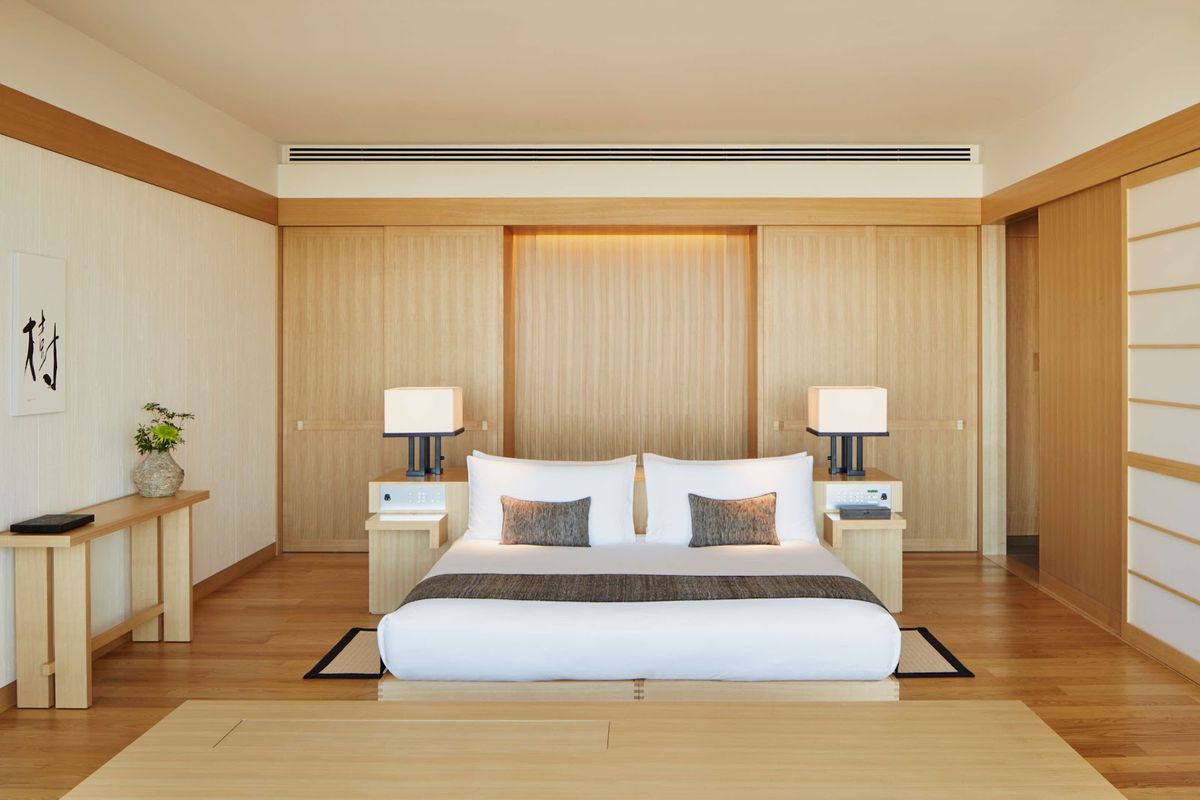
There are 84 rooms and suites — among the largest entry-level rooms in any Tokyo luxury hotel. The smallest category, Deluxe, is 71 square metres. The Aman Suite, at 157 square metres, is among the largest single-key residences in the city. Every room is finished in Hill's signature palette: basalt stone, cypress wood, washi paper screens, and the largest bathtubs in Tokyo — Japanese ofuro tubs hand-crafted from camphor wood, set against floor-to-ceiling windows looking down across the city. Premier rooms face the Tokyo Skytree; Aman Suites and corner suites command the Imperial Palace gardens and, on a clear winter morning, Mount Fuji a hundred kilometres west.
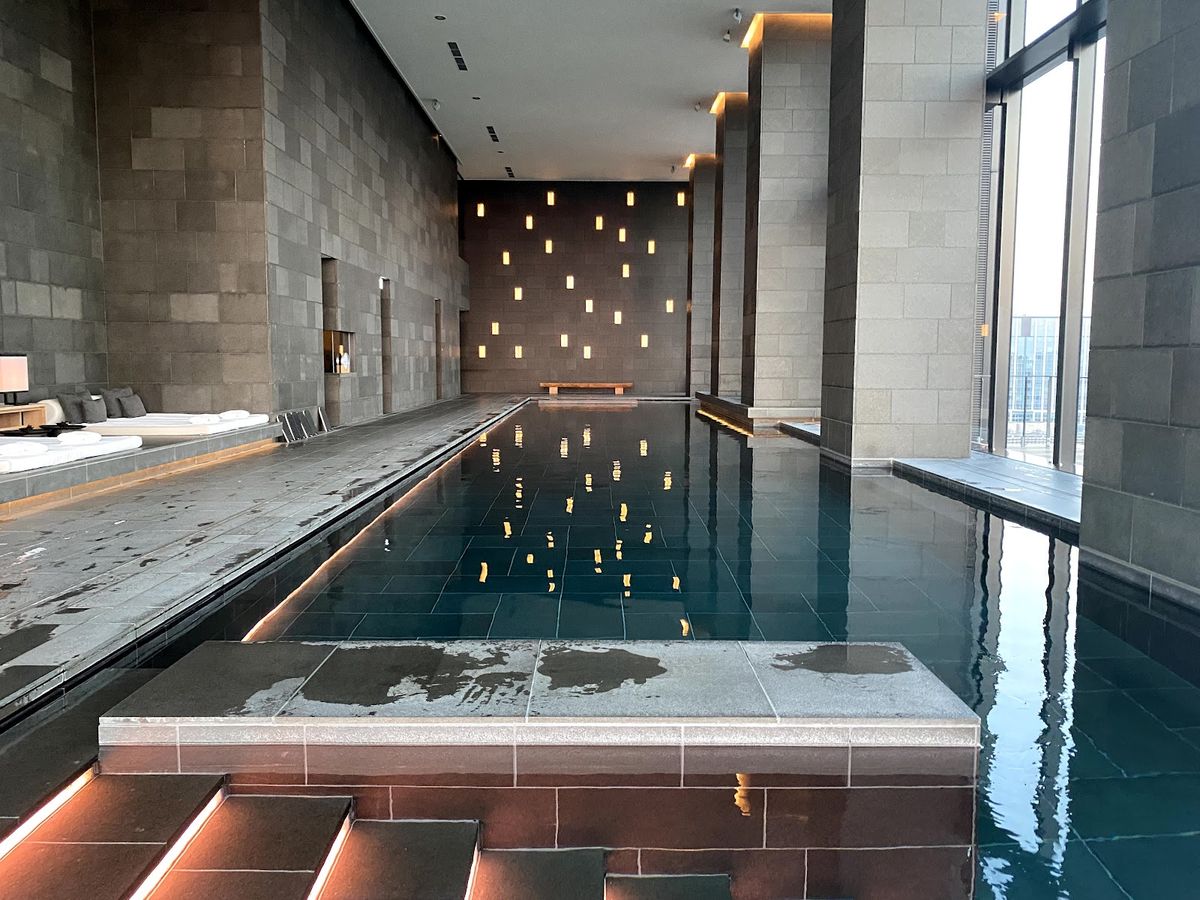
Arva, on the 33rd floor, serves a quietly inventive Italian-Japanese tasting menu in a long stone room that opens onto a garden of 186 trees. Musashi by Aman is the eight-seat sushi counter run by chef Hiroyuki Musashi, formerly of Sukiyabashi Jiro — one of the most difficult reservations in central Tokyo. The Lounge by Aman, on the 33rd floor, is open all day for tea ceremony, kaiseki bento, and an evening cocktail programme. The Aman Spa is the largest of any hotel in central Tokyo at 2,500 square metres, with a 30-metre swimming pool finished in dark stone, a sequence of onsen-style hot pools, and twelve treatment rooms.
Where it ranks against rivals
For a 2026 solo trip at this level, the most direct comparisons are Amankora in Bhutan (#3 on this list), The Connaught in London (#5 on this list), Aman Kyoto in Kyoto (#2 on this list). Aman Tokyo earns the higher rank for one or two specific reasons covered in the verdict above — usually a combination of architectural privacy, the bar that holds for one, and the staff continuity that makes a multi-night solo stay feel held rather than transactional. The other properties are not lesser hotels — in some cases the answer for your particular trip is the runner-up.
Practical: getting in
Address: The Otemachi Tower, 1-chōme-5-6 Ōtemachi, Chiyoda City, Tokyo 100-0004, Japan. Solo-suited categories — the executive king with the working desk, the studio suite with the right bath, the small villa with private outdoor space — book three to six months ahead in shoulder season. Some of the smallest properties on this list (Rachamankha, Yufuin Tamanoyu, Belmond Phou Vao) book twelve months ahead. The full review at the hotel page has current rates and the room categories worth paying up for. Use the solo retreat occasion page for the broader context.