Amanjena ranks #7 on our 2026 list of the best solo retreat hotels in the world. The case below explains why — the architecture, the bar, the suite ritual, and the alternatives we measured it against.
“Aman's Marrakech property — 39 pavilions and pools surrounded by olive groves with the Atlas Mountains in the distance. Aman tradition meets Moroccan setting.”
The hotel itself
"Opened 2000 fifteen kilometres south of central Marrakech in the palmeraie — Aman's first Moroccan resort and Ed Tuttle's most considered piece of North African pisé architecture. 32 pavilions, six private Maisons, sixteen hectares of olive grove, and the Atlas Mountains rising directly on the southern horizon."
Amanjena opened in 2000 fifteen kilometres south of central Marrakech in the palmeraie — the historic palm grove that surrounds the southern edge of the city. The brief, given to Aman founder Adrian Zecha and the brand's late architect Ed Tuttle (the architect of Amanpuri, Amanjiwo, and the original Aman aesthetic), was to translate Tuttle's signature pavilion-and-pool architecture into a Moroccan-pisé-and-zellij vocabulary. Twenty-five years later, the result remains the most quietly considered piece of Aman architecture anywhere in North Africa — and the property the entire Aman brand North African expansion was built around.
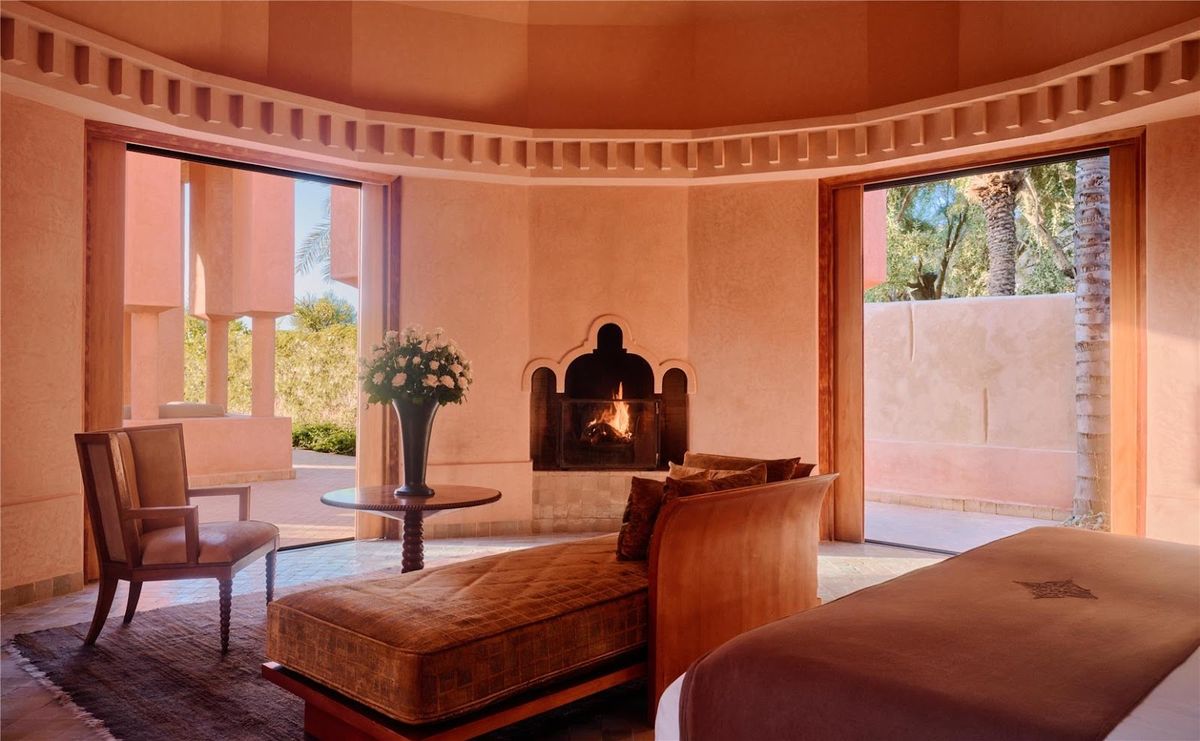
There are 32 pavilions and six private Maisons across the resort's sixteen hectares of olive grove. The Pavilions, the entry category, run from 173 to 245 square metres — exceptional for an entry-level room — each with a private walled garden, a saltwater plunge pool in some categories, and a fireplace inside the cedar-beamed bedroom. The Maisons are stand-alone two- and three-bedroom houses with full butler service, private chefs, and private pools. The Al Hamra Maison — the resort's flagship Maison — is a 850-square-metre house with three bedrooms, a private hammam, a private dining room, and a swimming pool larger than most Marrakech hotel central pools.
Why it works for a solo trip
Solo travel to a creative city is structurally different from couples travel to the same city. The trip is built around looking — at architecture, at art, at the way the local people drink coffee in the morning. Properties that earn solo-list inclusion in Kyoto, Marrakech, Tokyo, Big Sur, Sedona are the ones where the architecture itself rewards being alone in it: the courtyard you can sit in for an hour, the room with the right desk, the bath you can disappear into for ninety minutes.
Aman is the luxury group most calibrated for solo travel. Founded in 1988 by Adrian Zecha and now owned by Russian-American developer Vladislav Doronin, Aman has built its identity around the deliberate solitude that other luxury groups treat as an exception. The architecture is restrained. Service is anticipatory but never theatrical. Suites are oversized — Aman has the largest standard rooms of any luxury brand at scale, which matters disproportionately when you are using one for a week alone. The brand is famous for the kind of multi-night stays where guests check in, do not check out, and lose track of what day it is. For a solo retreat the Aman case is structural: the property is built for the trip you are taking.
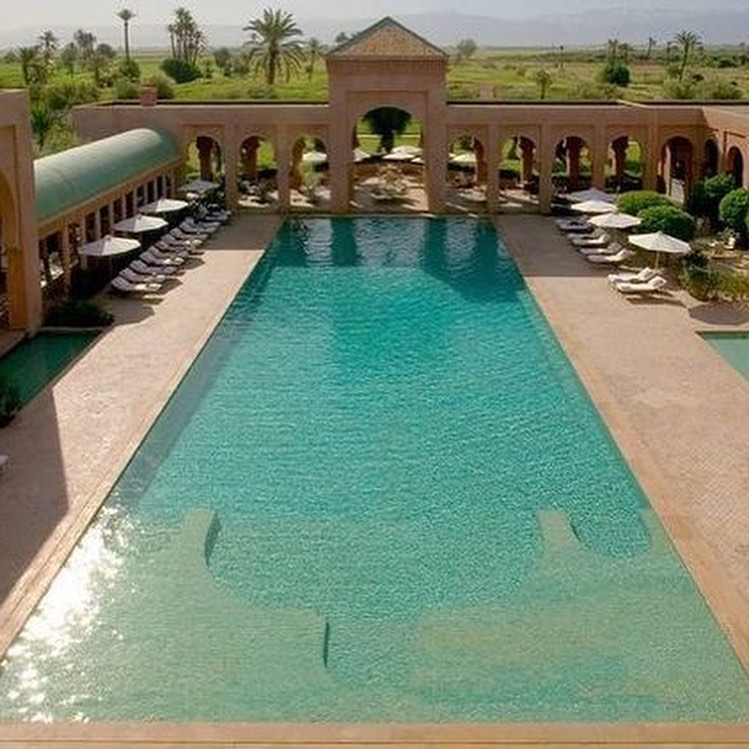
Architecture is the resort's outsized achievement. Tuttle worked with Moroccan craftsmen to develop a pisé-construction technique calibrated for hotel-grade durability — the buildings are walls of compressed Atlas earth, layered with pigmented limestone, finished by hand. The central bassin — a 50-metre traditional Moroccan reflecting pool — runs through the resort's centre, with palms and olive trees lining the walk. The 25-metre swimming pool is finished in green tadelakt plaster. The hammam, in the resort's southwestern corner, is among the most-considered traditional Moroccan-medicine spaces in the country.
What separates Amanjena, in 2026, is the deliberate Aman quietness applied to a Moroccan setting. There are no live entertainment programmes. There is no Saturday brunch culture. There are no nightclubs in earshot. The resort is reached via a quiet country road from central Marrakech (twenty-five minutes by hotel car), and once on the property, the Marrakech medina becomes a background reference rather than a live presence. For a wellness-led Moroccan stay where introvert quiet is the point, an introvert's anniversary or honeymoon, or a private Maison stay at heads-of-state level, this is the deliberate Aman answer.
Where it ranks against rivals
For a 2026 solo trip at this level, the most direct comparisons are Rachamankha in Chiang Mai (#6 on this list), Amantaka in Luang Prabang (#8 on this list), The Connaught in London (#5 on this list). Amanjena earns the higher rank for one or two specific reasons covered in the verdict above — usually a combination of architectural privacy, the bar that holds for one, and the staff continuity that makes a multi-night solo stay feel held rather than transactional. The other properties are not lesser hotels — in some cases the answer for your particular trip is the runner-up.
Practical: getting in
Address: km 12, Route de Ouarzazate، Marrakech 40000, Morocco. Solo-suited categories — the executive king with the working desk, the studio suite with the right bath, the small villa with private outdoor space — book three to six months ahead in shoulder season. Some of the smallest properties on this list (Rachamankha, Yufuin Tamanoyu, Belmond Phou Vao) book twelve months ahead. The full review at the hotel page has current rates and the room categories worth paying up for. Use the solo retreat occasion page for the broader context.