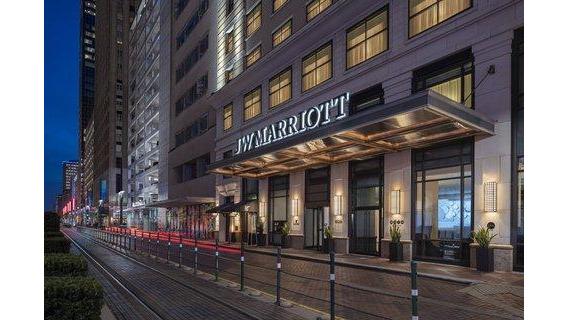
Houston, Texas · Five-Star Heritage · ★★★★
JW Marriott Houston Downtown
The 1910 Carter Building — once the tallest in Texas — restored as a 328-room heritage hotel on Main Street.
The 1910 Carter Building — once the tallest in Texas — restored as a 328-room heritage hotel on Main Street.
"The 1910 Carter Building was once the tallest building in Texas. A century later it has been brought back as a hotel with brass, marble, and a sense of architectural seriousness that downtown Houston rarely manages. The room rate, for what you get, is the bargain of Main Street."
The Samuel F. Carter Building opened in 1910 at the corner of Main and Rusk, and for a brief period it held the title of tallest building in Texas — sixteen floors of cream-coloured terracotta and limestone over a steel skeleton, designed by Sanguinet & Staats in the Beaux-Arts vocabulary then favoured for serious commercial addresses across the South. It was the building that announced Houston was no longer a frontier town. After a century of varied lives — banks, offices, near-demolition — it was reborn in 2014 as the JW Marriott Houston Downtown, a $90 million restoration that re-earned the building its place on the National Register of Historic Places and gave the city its most architecturally serious downtown stay.
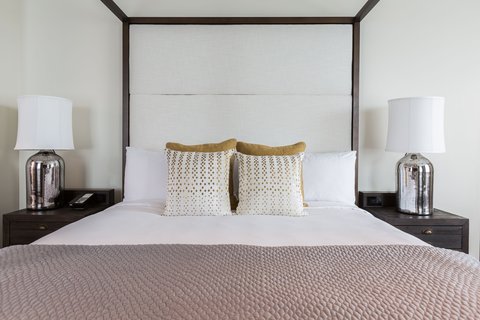
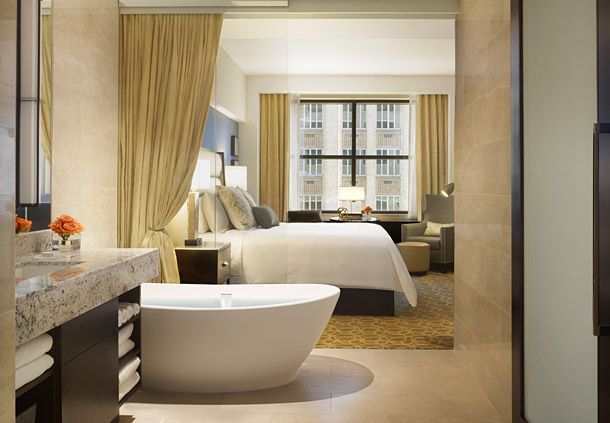
The conversion was handled with patience. The street-level lobby, with its marble columns, brass detailing, and original coffered ceilings, has been restored rather than reinvented — the kind of room that immediately tells out-of-town clients they were brought somewhere that takes the city's history seriously. The 328 rooms above are spread across the original sixteen floors, and the architectural quirks of a 1910 building have been retained: ceilings vary, no two corners are identical, window depths reveal the original wall thickness. Rooms are larger than the JW Marriott category usually suggests — Houston is not a city that runs short on space — and finishes are subdued tones of grey, taupe, and warm wood, with marble bathrooms and views over Main Street, the Theater District, and downtown's restored grid.
Main Kitchen, the lobby-level restaurant, is the hotel's most visible amenity and the one most worth booking on arrival night. The kitchen leans into Texas-Mediterranean — wood-fired, gulf seafood, a serious wine list, breakfast that genuinely earns the word "power" — and the dining room itself, in the building's restored original banking hall, is one of the more handsome restaurant rooms downtown. The bar adjoining the lobby is the right place for a quiet evening drink before walking to the Theater District, and the JW Lounge for executive-level guests delivers the corporate-traveller benefits the brand has standardised across the world.
The wellness floor includes an indoor pool, a fitness centre that is genuinely well-equipped rather than tokenistic, and a spa with a treatment menu that runs from straightforward massage to a more involved Texas-themed signature ritual. The pool is the small but pleasant kind — useful for a swim before a meeting, not a destination in its own right. The hotel's connection to the Houston downtown tunnel system is the real structural advantage in August: seven miles of climate-controlled pedestrian passage connect to the convention centre, the courthouses, and most of downtown's office towers, meaning a guest can reach a meeting at one of the energy majors without stepping outside.
The location is the third reason the hotel works. Main Street has been the spine of downtown Houston for a century, and the JW Marriott sits at the most active stretch — the Theater District is four blocks north, Discovery Green and the convention centre are six blocks east, the Toyota Center is eight blocks south, and the METRORail Red Line stop is across the street, making the Museum District a fifteen-minute ride away. For a downtown business stay that wants the architectural backdrop without the rate of the Four Seasons or Post Oak, the JW Marriott Houston Downtown is the most considered answer the city offers. From $310 per night for a king room, with executive-floor and suite categories climbing modestly from there, the value calculation is straightforward.
For corporate trips into downtown Houston, the JW Marriott solves the three problems that matter: tunnel-system access to the convention centre and most of the office towers, a serious lobby that telegraphs the right thing to a client at first sight, and a Main Kitchen dining room that handles client dinners without requiring a reservation across town. Request an executive-floor room for the JW Lounge, which provides workable breakfast and evening canapés. The rate, against Four Seasons or Post Oak, is genuinely the value play of downtown.
Houston with kids is a logistical exercise — the Space Center, the Museum District, and Discovery Green all need addressing in three days. The JW Marriott's downtown location puts Discovery Green and the METRORail in walking distance, the indoor pool gives a reliable late-afternoon recovery option after a day in Texas heat, and the larger king and suite categories accommodate four without rollaway gymnastics. For families wanting downtown over Memorial, this is the most architecturally interesting choice the city offers at the price point.
For an anniversary stay that values architecture over flash, the JW Marriott rewards the choice. Book a high-floor king with a Theater District view, a table at Main Kitchen for the night of, and time the stay to a Houston Symphony or Houston Grand Opera performance four blocks north — the walk back through downtown after a concert, with the Carter Building's restored façade lit gold above Main Street, is the kind of small theatrical moment a city anniversary should deliver. The spa adds a sensible morning-after element. Less expensive than the alternatives, and arguably the more memorable room.
Rates checked May 2026. Price may vary by date.
JW Marriott Houston Downtown delivers the city's most architectural address at the price point. Tunnel access, Main Kitchen, and a 1910 building behind it — that's the package.
See All Business HotelsNew hotel openings, deal alerts, and occasion-specific guides — weekly.